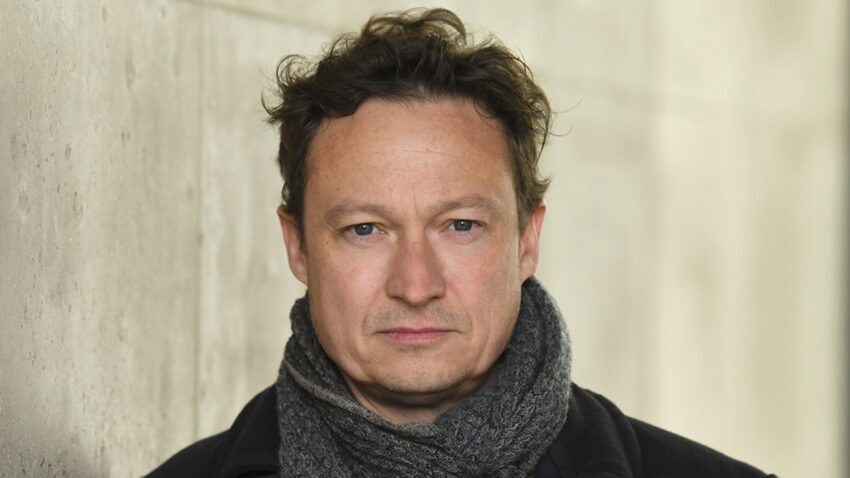
Who Is Gabriel Gatehouse?
When Gabriel Gatehouse launched “The Coming Storm” podcast on BBC Radio 4 in January 2022, he introduced himself to listeners with a challenge that would define the series: “If you think you’re immune,” he said, “I dare you to listen.” It was a statement entirely in keeping with the man behind it, a journalist who has built a career on walking into the most dangerous and disorienting situations on earth, not with the swagger of the war correspondent but with the quiet, determined intellectual curiosity of someone who genuinely wants to understand what he is seeing.
The podcast became the most downloaded BBC production of its first quarter, attracting around three million listens on BBC Sounds alone, and established Gatehouse not merely as one of the BBC’s most trusted foreign correspondents but as one of the defining voices in the global conversation about misinformation, political extremism, and the erosion of shared reality.
Gabriel Gatehouse is a British journalist and broadcaster who spent more than two decades at the BBC, where he served as International Editor of the flagship current affairs programme Newsnight and co-hosted Ukrainecast on BBC Sounds.
Over that career, he reported from virtually every significant conflict zone of the early twenty-first century, Ukraine, Syria, Libya, Iraq, East Africa, filing dispatches that balanced rigorous factual grounding with the kind of human storytelling that makes abstract geopolitical crises feel real and personal to the people watching and listening at home.
His most celebrated work, “The Coming Storm,” began as a podcast and evolved into a critically acclaimed book published in September 2024, a deep, disturbing investigation into the conspiracy theories that animated the January 6, 2021 storming of the U.S. Capitol and the radical new political movement that has since grown around them. The work earned praise from figures as varied as Louis Theroux, Jon Stewart, and The Guardian, and cemented Gatehouse’s place among the most important investigative journalists working in the English language today.
Profile
| Full Name | Gabriel Gatehouse |
| Age | Early 50s (exact date of birth not publicly disclosed) |
| Birthplace | United Kingdom |
| Nationality | British |
| Occupation | Journalist, Broadcaster, Author, Podcast Presenter |
| Religion | Christianity (reported) |
| Net Worth | Not publicly disclosed |
Early Life
Gabriel Gatehouse was born and raised in the United Kingdom. Specific details about his date of birth, hometown, and family background remain largely outside the public domain, a reflection of the private nature he has maintained throughout his career, directing public attention to his journalism rather than his personal story. What is known is that he showed an early passion for both music and language, developing interests that would each, in different ways, leave their mark on his life and work.
Gatehouse has spoken publicly about his early ambition to pursue a career as a jazz pianist. Music was his first serious pursuit, and he invested enough time and effort in it to understand what it meant to be genuinely committed to an art form. The decision to abandon that path, or, as he has described it, his failure to make it as a jazz musician, redirected his considerable intellectual energies into journalism. It was a transition that, with the benefit of hindsight, the world of reporting has been enormously fortunate to have received. His musical sensibility, though he traded the piano for a microphone, never entirely left him; it informs the rhythmic quality of his storytelling and the patience with which he constructs a narrative arc across a long-form investigation.
His passion for languages, particularly Russian, which he studied to a high level, gave him an early competitive advantage in a profession where understanding the cultures and politics of the former Soviet world became increasingly essential as the twenty-first century unfolded. That linguistic ability, combined with an instinct for stories that others might overlook, shaped the particular flavour of his journalism: detailed, internationally grounded, and always attentive to the human beings at the centre of large events.
Education
Gabriel Gatehouse pursued a degree in Russian language and literature, a course of study that reflected both his linguistic aptitude and his intellectual interest in Eastern Europe and the post-Soviet world. His academic background in Russian gave him the cultural and political tools to analyse the complex dynamics of Russia and its neighbours with a depth that would prove invaluable across decades of reporting on the region. The specific institution he attended has not been widely reported.
Career
Gabriel Gatehouse began his professional life at the BBC in what might seem an unglamorous starting point: cutting reel-to-reel tape with a razor blade in the BBC’s Russian language service. It was painstaking, technically demanding work that taught him the craft of audio storytelling from its most fundamental elements, how sound is constructed, how silence functions in a piece of journalism, and how precision in editing shapes the emotional and informational impact of a broadcast. This grounding in the mechanics of audio journalism would later inform the extraordinary quality of his podcast work.
His role in the Russian service also deepened his understanding of how the post-Soviet world functioned, how Russian political culture differed from Western liberal assumptions, and how the narratives that circulated within Russia shaped the country’s internal and external behaviour. That knowledge would prove prescient as Russia’s role in global politics became increasingly confrontational and as disinformation, a concept with deep roots in Soviet intelligence tradecraft, became a defining feature of the contemporary political landscape.
From his behind-the-scenes work in the Russian service, Gatehouse transitioned into on-the-ground reporting, and he quickly distinguished himself as a field correspondent of the highest order. He was based at various points in East Africa, Libya, Iraq, Russia, and Ukraine, postings that covered some of the most violent and complex stories of the era. He covered the Ebola outbreak in West Africa, reporting from the heart of a public health crisis that was as politically fraught as it was medically catastrophic. He reported on the rise and consolidation of ISIS in Iraq, a story that required deep contextual knowledge of the country’s history, sectarian dynamics, and the consequences of the 2003 invasion. He was in Libya during the civil conflict that followed the fall of Muammar Gaddafi, and in Ukraine both before and after Russia’s full-scale invasion, work that contributed to “Ukrainecast,” the BBC Sounds podcast he co-hosted and which became one of the corporation’s most important reporting vehicles for the conflict.
In the United States, Gatehouse spent significant time covering the political upheaval of the Trump era, reporting extensively on the forces, cultural, economic, technological, and psychological, that transformed American political life. It was this American reporting that led him toward what would become his most celebrated project. In the wake of the January 6, 2021 storming of the U.S. Capitol, Gatehouse began a deep investigation into the conspiracy theories and political movements that had fuelled the event. The result was “The Coming Storm,” a five-part BBC podcast launched in January 2022 that traced the roots of QAnon and the radical right from the earliest years of the Clinton administration through to the insurrection and beyond. The podcast was an immediate critical and popular success, becoming the most downloaded BBC podcast of its first quarter and attracting around three million BBC Sounds downloads in that period alone. It was shortlisted for the Orwell Prize for Journalism in 2022 and won the Broadcasting Press Guild Award in 2023.
His investigation into Vladislav Surkov, the Russian political strategist known as “Putin’s Rasputin”, produced “The Puppet Master,” a five-part investigative series for BBC Newsnight that won the Prix Europa award in 2019. The series was a landmark piece of journalism that illuminated the philosophical and operational underpinnings of Russia’s approach to political warfare, disinformation, and the deliberate blurring of truth and fiction in the service of state power. It remains one of the most significant pieces of long-form broadcast journalism about Russia’s role in the contemporary information environment.
In 2024, Gatehouse published “The Coming Storm: A Journey into the Heart of the Conspiracy Machine” through Penguin Books. The book expanded significantly on the podcast’s themes, weaving personal reportage with historical research to trace how a loose alliance of internet trolls, white supremacists, tech entrepreneurs, and radically disenchanted political actors built the infrastructure of a new kind of politics, one that did not merely dispute facts but actively dismantled the shared epistemological ground on which democratic debate depends. The book was praised by The Guardian as offering a “grand and somewhat terrifying narrative” and was described by The Telegraph as the work of “a magnificent storyteller.” Jon Stewart called it “revelatory, scary, and brilliantly told.”
Awards & Nominations
- Prix Europa (2019), for “The Puppet Master,” investigation into Vladislav Surkov
- Foreign Press Association Award (2020), for coverage of the Hong Kong protests
- Shortlisted, Orwell Prize for Journalism (2022), for “The Coming Storm” podcast
- Broadcasting Press Guild Award (2023), for “The Coming Storm” podcast
- “The Coming Storm” podcast: most downloaded BBC Sounds podcast in Q1 2022, with approximately 3 million downloads on BBC Sounds
Social Media
Gabriel Gatehouse maintains a presence on social media platforms where he shares his journalism, commentary, and updates on his work.
- Twitter/X: @gabrielgathouse,
- BBC Profile: available via bbc.co.uk
- Book/Author Page: available via penguin.co.uk and aevitascreative.com
Personal Life
Gabriel Gatehouse keeps his personal life almost entirely private. No confirmed information is available in the public domain about his marital status, romantic relationships, or family composition, and he has consistently directed attention away from his personal circumstances and toward his journalistic work. He is based in London and is known to write regularly for publications including the New Statesman and The Times in addition to his BBC work. His intellectual interests span politics, history, philosophy, and music, the last a reminder of the jazz pianist he once hoped to be. That biographical detail, which he has shared in public contexts, humanises a career that can otherwise appear to move from one extreme situation to the next, and points to a creative sensibility that has clearly shaped the storytelling quality that distinguishes his journalism from that of many of his peers.
Net Worth
Gabriel Gatehouse has not publicly disclosed his financial details, and no reliable estimate of his net worth is available.
As a senior BBC journalist and international editor over more than two decades, his earnings would reflect the BBC’s senior correspondent pay structure. Additional income has come from his book “The Coming Storm” published by Penguin in 2024, from speaking engagements as a sought-after commentator on disinformation and political extremism, and from his freelance writing for publications including the New Statesman and The Times. The commercial success of “The Coming Storm” podcast, which attracted millions of listeners globally, will also have contributed to his profile and earning power in the book and speaking markets.
Bibliography & Notable Works
- “The Coming Storm”, BBC Radio 4 podcast, launched January 2022. Five-part investigation into QAnon and the conspiracy theories behind the January 6 Capitol storming. Most downloaded BBC podcast in Q1 2022. Shortlisted for the Orwell Prize for Journalism (2022), winner of the Broadcasting Press Guild Award (2023).
- “The Puppet Master”, BBC Newsnight five-part investigative series (2019) on Russian political strategist Vladislav Surkov. Winner of the Prix Europa (2019).
- “Ukrainecast”, BBC Sounds podcast (co-host). Ongoing coverage of Russia’s war in Ukraine.
- “The Coming Storm: A Journey into the Heart of the Conspiracy Machine”, Book, published by Penguin/Ilex Press, September 2024. Expanded and updated account of the conspiracy forces reshaping American and global democracy. Shortlisted for the Orwell Prize for Political Writing.
- Regular contributor to the New Statesman, The Times, and other publications on geopolitics, disinformation, and political culture.
Conclusion
Gabriel Gatehouse’s career represents the best traditions of public-interest journalism: rigorous in its research, human in its storytelling, and courageous in its willingness to follow difficult truths into uncomfortable places.
From the rubble of Syrian cities to the fractured digital landscape of American political culture, he has consistently produced journalism that does more than describe events, it illuminates the forces shaping them, and in doing so, equips its audience to understand the world with greater clarity and greater unease.
His book “The Coming Storm” arrived at a moment when the forces it documents, conspiracy theory, digital disinformation, the weaponisation of paranoia, were not receding but accelerating. That makes his work not just historically significant but urgently necessary.
In a media environment increasingly fragmented by algorithm and incentive, Gatehouse’s commitment to the long, patient, deeply researched narrative stands as both a professional benchmark and a reminder of what journalism at its finest can accomplish.