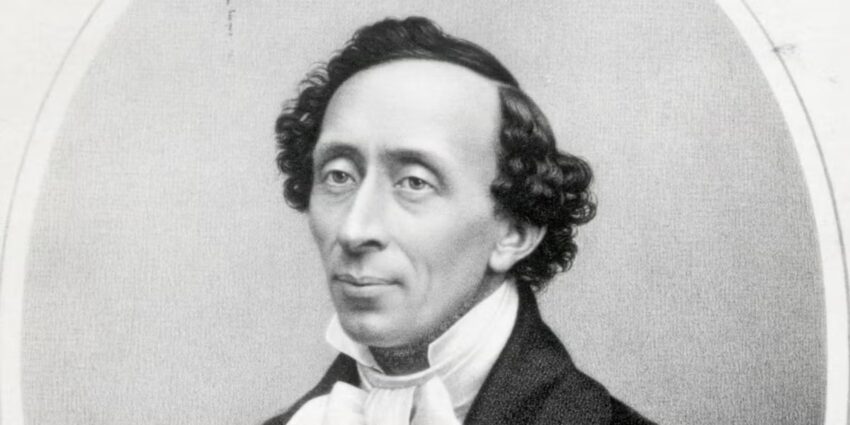
Few writers have shaped the imagination of children, and adults, across more cultures than Hans Christian Andersen. A poor shoemaker’s son from provincial Denmark, he went on to write tales so enduring that more than a century and a half after his death, “The Little Mermaid,” “The Ugly Duckling,” and “The Snow Queen” remain instantly recognisable to readers in over 125 languages.
Hans Christian Andersen was a Danish author best known for his literary fairy tales, a body of work spanning 156 stories across nine volumes that broke decisively from the more rigid, moralistic children’s literature of his era.
Unlike the Brothers Grimm, who collected and recorded existing European folk tales, Andersen largely invented his own stories, drawing heavily on the hardships, longings, and emotional textures of his own unusual life.
His story matters globally because it is, in many ways, as fantastical as the tales he wrote. Rising from genuine poverty in provincial Odense to becoming a favourite of European royalty and a friend to figures such as Charles Dickens, Andersen’s own biography reads, by his own admission and that of his biographers, remarkably like one of his own fairy tales.
Profile
| Full Name | Hans Christian Andersen |
| Born | 2 April 1805 |
| Birthplace | Odense, Denmark |
| Nationality | Danish |
| Occupation | Author, Poet, Playwright |
| Parents | Hans Andersen (shoemaker), Anne Marie Andersdatter (washerwoman) |
| Relationship Status | Never married |
| Date of Death | 4 August 1875, Copenhagen, Denmark |
Early Life
Hans Christian Andersen was born on 2 April 1805 in Odense, on the Danish island of Funen, the only child of Hans Andersen, a poor shoemaker, and Anne Marie Andersdatter, a washerwoman who was illiterate. Though the household lacked money, his father encouraged Hans’s imagination from an early age, reading him stories from One Thousand and One Nights and the Bible, and taking him to see plays by the Danish dramatist Ludvig Holberg. His father also built him a small toy theatre, which the young Andersen used to stage plays with handmade puppets, an early outlet for the storytelling instincts that would define his later life.
Andersen lost his father at the age of eleven, a loss that had a profound effect on him, and his already modest family circumstances grew more precarious afterward. As a child, he also absorbed folk tales from elderly women at the Odense Hospital, material that, alongside the stories his grandmother told him, would later surface throughout his fairy tales. Hypochondriacal by nature and prone to anxiety, partly out of fear that he might inherit the mental illness that had affected his paternal grandfather, Andersen nonetheless developed a reputation among acquaintances as witty and engaging company.
Education
At the age of fourteen, in 1819, Andersen left Odense for Copenhagen with dreams of becoming a famous actor, having declared to his mother that he would first suffer cruelly and then become famous. His attempts to establish himself at the Royal Theatre were unsuccessful, and his schooling, which followed in the towns of Slagelse and Helsingør on the island of Zealand, proved deeply unhappy. He was an average student, likely affected by dyslexia, and was mocked by classmates for his ambitions as a writer; he later described his time at school, where he also lived for a period at his abusive headmaster’s home, as the most miserable period of his life.
In 1827, theatre director Jonas Collin, who became Andersen’s most important early patron, intervened to remove him from this hostile school environment and arranged for him to complete his studies privately in Copenhagen instead. The following year, at 23 years old, Andersen passed the necessary examinations to enter the University of Copenhagen, finally gaining access to the kind of education that had been closed off to him by his impoverished background.
Career
Andersen’s first notable literary success came in 1829, during his first year at university, with a fantastical short story titled “A Journey on Foot from Holmen’s Canal to the East Point of Amager,” written in the style of the German Romantic author E.T.A. Hoffmann. Several poems followed with moderate success, but a string of harshly criticised pieces afterward led Andersen into a nervous breakdown, an early sign of the emotional intensity that would mark much of his creative life.
Travel quickly became one of Andersen’s defining passions and a recurring source of literary material. Beginning in 1831, and supported from 1833 by a travel grant from King Frederik, he embarked on the first of what would eventually total around thirty extended journeys across Europe, spending a combined fifteen years of his life abroad over the course of his career. He often declared that “to travel is to live,” and his vivid travelogues, though now largely overshadowed by his fairy tales, were highly regarded in their time. During a stay in Italy, he began work on what would become his first major literary breakthrough, the autobiographical novel The Improvisatore, published in 1835 to widespread success and quickly translated into French and German.
That same year, 1835, also marked the beginning of Andersen’s most enduring legacy: the publication of his first collection of fairy tales, Eventyr, fortalte for børn (“Fairy Tales, Told for Children”), which included “The Tinderbox,” “Little Claus and Big Claus,” “The Princess and the Pea,” and “Little Ida’s Flowers.” Although critics initially found the tales too casual and conversationally styled, lacking clear moral instruction, the stories proved revolutionary precisely because of this approach. Andersen used the idioms and rhythms of everyday spoken Danish rather than the formal literary language typical of children’s writing at the time, creating stories that felt comic, conspiratorial, and alive in a way readers had not previously encountered.
Andersen continued to expand the fairy tale collections throughout the following decades, publishing further volumes in 1837, 1842, 1843, 1847, and 1852, alongside Billedbog uden billeder (“A Picture Book Without Pictures”) in 1840. From 1848 onward, he devoted himself almost exclusively to fairy tales, and beginning in 1849, he also wrote fairy-tale plays for the Copenhagen stage. Between 1852 and 1862, he released nine further volumes of new stories, somewhat more moralistic in tone than his earlier work, followed by additional volumes in 1865 to 1866 and a final series in 1871 to 1872, eventually compiled under the title Nye eventyr og historier (“New Fairy Tales and Stories”).
Many of Andersen’s most celebrated tales drew directly from his own childhood experiences and emotional life. The new shoes given to him for his first Communion became the cursed footwear of “The Red Shoes,” his mother’s flower boxes inspired imagery in “The Snow Queen,” and his own struggles as a physically frail, unconventional-looking child became the foundation for “The Ugly Duckling.” His unhappy romantic life, including his unrequited feelings for opera singer Jenny Lind, has often been linked by scholars to the melancholic, self-sacrificing love depicted in “The Little Mermaid.” In 1847, during travels in England, Andersen met Charles Dickens and formed a close friendship with him, reflecting the wide circle of European literary and cultural figures he came to know throughout his career.
By 1867, Andersen received the freedom of his home city of Odense, fulfilling what was popularly described as a long-standing local prophecy that the city would one day be illuminated in his honour. Although he remained a prolific writer of plays, novels, poetry, and travelogues throughout his life, including the autobiographical work The Fairy Tale of My Life in 1855, it is overwhelmingly his fairy tales that secured his lasting global reputation.
Honours & Recognitions
- Granted the freedom of his native city of Odense (1867)
- Hans Christian Andersen Awards, the most prestigious international recognition in children’s literature, named in his honour
- The Little Mermaid statue, commissioned by the Danish government in 1909, erected in Copenhagen Harbour
- Statue erected in his honour in New York City’s Central Park
- Denmark’s bicentenary celebrations marking 200 years since his birth (2005)
Personal Life
Hans Christian Andersen never married and, by most biographical accounts, struggled with loneliness and unfulfilled romantic longing throughout much of his adult life. His most documented infatuation was with Swedish opera singer Jenny Lind, whom he met in 1843 and pursued with deep feeling, though she did not return his romantic interest, viewing him instead as a brother figure. This unreciprocated love is widely believed to have influenced the emotional core of several of his tales, including “The Nightingale” and “The Little Mermaid.”
Andersen’s biographers have also explored the possibility of romantic attachments to men during his life. According to biographer Jackie Wullschläger, Andersen may have had a romantic and possibly sexual relationship later in life with Danish ballet dancer Harald Scharff, whom he met when Andersen was in his fifties; Andersen’s own journals, by this account, suggest deep infatuation, including a gift of a silver toothbrush Scharff gave him on his 57th birthday. Scholars continue to debate the full nature of Andersen’s romantic and emotional life, given the limited and sometimes ambiguous nature of the surviving historical record.
Outside his writing, Andersen became known among friends and their children for his skill at paper cutting, an artistic hobby he frequently used to entertain. Though sustained throughout his life by close friendships, including his relationship with patron Jonas Collin’s family, Andersen never established a household or family of his own.
Net Worth
Detailed financial records from Andersen’s lifetime are not widely available in modern net worth terms, as the concept of a precisely calculated personal fortune was not commonly tracked or reported in 19th-century Denmark. He earned his living primarily through the sale and publication of his fairy tales, novels, plays, and travelogues, alongside royal travel stipends, including the grant he received from King Frederik in 1833, which supported much of his extensive travel writing career.
Andersen’s fairy tales, given their enormous and continuing global popularity, have generated substantial revenue across the nearly two centuries since their publication, primarily benefiting publishers, translators, and adaptors rather than Andersen himself, who died well before the era of modern copyright and licensing structures. His true enduring wealth lies instead in the cultural and literary legacy of his work, which continues to be translated, adapted, and read worldwide.
Bibliography & Notable Works
- The Improvisatore (1835)
- Fairy Tales, Told for Children (1835) — including “The Tinderbox,” “The Princess and the Pea”
- “The Little Mermaid” (1837)
- “The Ugly Duckling” (1843)
- “The Nightingale” (1843)
- “The Snow Queen” (1844)
- “The Red Shoes” (1845)
- “Thumbelina”
- “The Emperor’s New Clothes”
- “The Steadfast Tin Soldier”
- The Fairy Tale of My Life (autobiography, 1855)
- New Fairy Tales and Stories (1858–1872)
FAQs
When was Hans Christian Andersen born?
He was born on 2 April 1805 in Odense, Denmark.
What is Hans Christian Andersen best known for?
He is best known for his literary fairy tales, including “The Little Mermaid,” “The Ugly Duckling,” and “The Snow Queen.”
Did Hans Christian Andersen ever marry?
No, he never married and is widely believed to have experienced significant romantic difficulty and loneliness throughout his life.
When did Hans Christian Andersen die?
He died on 4 August 1875 in Copenhagen, Denmark, at the age of 70.
How many fairy tales did Hans Christian Andersen write?
He wrote 156 fairy tales and stories across nine volumes, translated into more than 125 languages.
Conclusion
Hans Christian Andersen’s life embodies the very transformation his most famous story describes: an awkward, overlooked beginning followed by an unexpected and remarkable flowering. From a shoemaker’s son mocked for his ambitions to a writer celebrated across royal courts and ordinary households alike, his journey mirrors the themes of resilience, longing, and quiet dignity that run through his fairy tales.
More than 150 years after his death, Andersen’s stories continue to be read, adapted, and reimagined across film, theatre, and literature worldwide, ensuring that the values and emotional truths he wove into his tales remain as relevant to new generations as they were to readers of his own era. His legacy endures not merely as children’s entertainment, but as a body of work that continues to speak honestly to readers of any age about loss, identity, and hope.