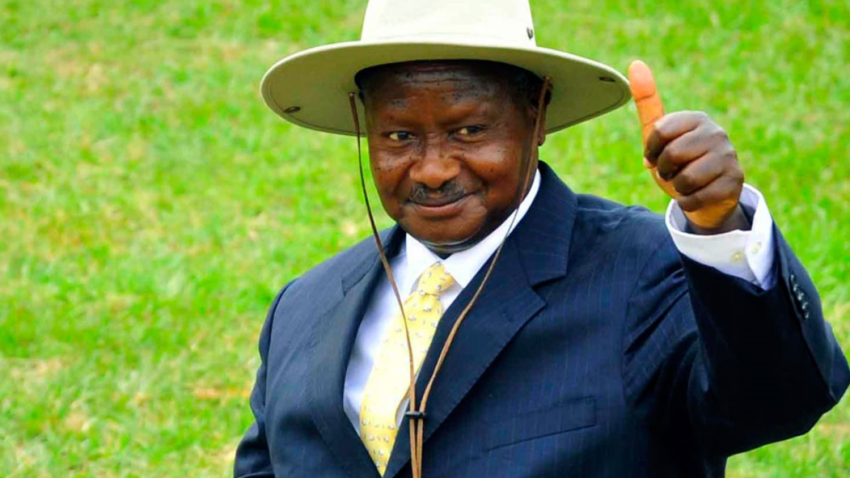
Yoweri Kaguta Museveni is the President of Uganda and one of the longest-serving heads of state in Africa, having led the country continuously since 1986.
Born on September 15, 1944, in Ntungamo district, western Uganda, he rose from a politically conscious student activist through a liberation struggle to seize power following a five-year guerrilla war that ended the governments of Milton Obote and Tito Okello.
He has governed Uganda for four decades, presiding over a period of economic growth and relative political stability in a country that had experienced devastating instability under Idi Amin and Obote, while simultaneously drawing significant international criticism for human rights abuses, electoral manipulation, and Uganda’s military interventions in the Democratic Republic of Congo.
Museveni is a complex and polarising figure, celebrated by admirers for bringing stability, reconciliation, and economic development to a post-conflict nation, and condemned by critics for progressively dismantling democratic norms, eliminating presidential term limits, removing the age cap on presidential candidates (enabling him to remain president past 75), and using state power to suppress opposition.
His role in regional politics across East and Central Africa, including Uganda’s involvement in various regional conflicts and his position on LGBTQ+ rights, has placed him repeatedly at the centre of international controversy.
Profile
| Full Name | Yoweri Kaguta Museveni |
| Born | September 15, 1944 |
| Age | 81 years old |
| Birthplace | Ntungamo, Uganda |
| Nationality | Ugandan |
| Occupation | President of Uganda, Military Officer |
| Religion | Christianity (Presbyterianism) |
| Spouse | Janet Museveni (married 1973) |
| Children | Muhoozi Kainerugaba, Natasha Karugire, Patience Rwabwogo, Diana Kamuntu |
Early Life
Yoweri Kaguta Museveni was born on September 15, 1944, in the Ntungamo area of western Uganda, into the Banyankole ethnic group. He grew up in a cattle-herding family and from an early age showed intellectual ambition and a strong interest in politics.
He was educated at Mbarara High School and then attended the University of Dar es Salaam in Tanzania, where he studied political science and economics.
At the University of Dar es Salaam he was deeply influenced by leftist political thought and became involved in student politics, becoming the chairman of the Front for the Liberation of Mozambique (Frelimo) student association.
He also met Julius Nyerere, whose vision of African socialism and pan-African solidarity deeply influenced his political thinking.
Education
Museveni earned a Bachelor of Arts degree in Political Science and Economics from the University of Dar es Salaam in 1970.
His university education in Tanzania, at a time when the institution was a hotbed of African liberation thinking, fundamentally shaped his political philosophy and his approach to governance and resistance.
Career
After university, Museveni returned to Uganda and worked briefly in the government of Milton Obote. When Idi Amin overthrew Obote in 1971, Museveni went into exile and began organising political and military resistance.
He founded the Front for National Salvation (Fronasa) which fought against Amin. After the removal of Amin in 1979, Museveni participated briefly in the post-Amin transitional government and in elections, before launching the National Resistance Army (NRA) guerrilla movement in 1981 following what he considered a rigged election.
The NRA fought a five-year bush war in the Luwero Triangle region of Uganda, ultimately capturing Kampala on January 26, 1986, a date Ugandans now commemorate as Liberation Day.
Museveni was sworn in as President on January 29, 1986. In his early years he pursued a broadly pragmatic governance approach, adopting economic liberalisation policies recommended by the IMF and World Bank while maintaining political control through a no-party system that banned political parties. Uganda’s economy grew substantially during the 1990s and 2000s, and the AIDS epidemic, which had devastated the country, was reduced through an aggressive public health campaign.
However, Museveni’s governance increasingly drew criticism for authoritarian tendencies. He amended the Constitution in 2005 to remove presidential term limits, enabling him to contest the 2006 election and subsequent elections.
In 2021, Parliament removed the age cap of 75 for presidential candidates, allowing him to stand for the 2021 election, which he won amid widespread reports of electoral violence and fraud. His son, Muhoozi Kainerugaba, a senior military general, is widely seen as a potential successor and has been politically active, raising concerns about dynastic succession.
Uganda under Museveni has been involved in multiple regional conflicts, including military interventions in the DRC, South Sudan, and Somalia (through AMISOM peacekeeping forces).
In 2023, Uganda passed the Anti-Homosexuality Act, one of the most severe pieces of anti-LGBTQ+ legislation in the world, drawing widespread international condemnation and sanctions from Western nations.
Awards & Honours
Museveni has received numerous African and international awards for economic development and regional security contributions during his early governance period.
He has been recognised by African Union bodies for his role in regional conflict resolution.
Social Media
President Museveni maintains an active presence on X (formerly Twitter) and Facebook, where he regularly posts on policy matters, agricultural activities at his farm, and national events.
His social media has attracted controversy for posts touching on regional geopolitics and personal opinions on national policy.
Personal Life
Yoweri Museveni married Janet Kataaha in 1973. Janet Museveni has herself been a prominent political figure, serving as First Lady, Minister of Education, and Member of Parliament.
The couple has four children: General Muhoozi Kainerugaba (army commander and political figure), Natasha Karugire, Patience Rwabwogo, and Diana Kamuntu, who passed away in 2021.
Net Worth
Yoweri Museveni’s net worth is not publicly disclosed in reliable verified sources.
As the head of state of Uganda for four decades, and with personal interests in large cattle ranching operations and real estate, his personal wealth has been the subject of considerable speculation. Specific verified figures are not available.
Conclusion
Yoweri Museveni’s four-decade presidency has shaped Uganda in both positive and deeply problematic ways.
The stability, economic growth, and reconstruction of national institutions that he oversaw from 1986 through the 1990s and 2000s represent genuine achievements in a country that had experienced catastrophic misrule under Amin and Obote.
The progressive erosion of democratic norms, the suppression of political opposition, the removal of constitutional limits on his power, and Uganda’s international isolation over the Anti-Homosexuality Act represent the other side of his legacy.
As Uganda approaches a presidential transition, whether imminent or eventual, the country’s ability to build democratic institutions that can function without Museveni at their centre will be the most consequential measure of his long governance.