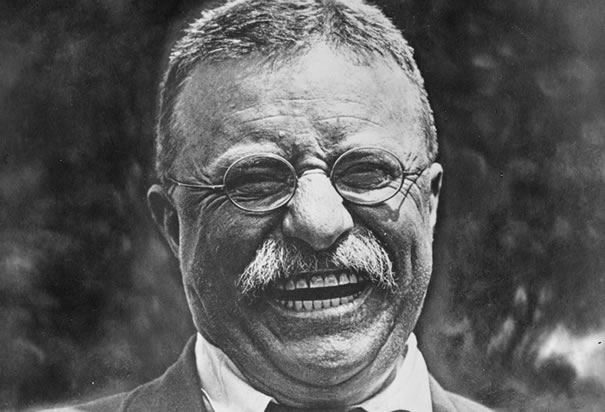
Who Was Theodore Roosevelt?
When Theodore Roosevelt became the 26th President of the United States on September 14, 1901, at the age of 42, following the assassination of President William McKinley, he was already one of the most extraordinary figures in American public life.
A former Harvard graduate, New York state legislator, frontier rancher, decorated war hero, police commissioner, assistant secretary of the Navy, and governor of New York, he brought to the White House a restless energy, a voracious intellect, and a philosophy of leadership that would permanently transform the American presidency.
Frank Sinatra would one day use a phrase about someone else, but it could equally have been said about Roosevelt from the moment he took power: this man was something entirely new.
Roosevelt’s story begins with physical frailty and ends with global statesmanship, and the arc between those two poles is one of the most compelling personal narratives in American history. As a sickly, asthma-ridden child in New York City, he was advised by doctors to lead a quiet, cautious life.
He chose the exact opposite: he made his body, as he put it, through a lifelong commitment to strenuous physical activity, and he applied the same unbending will to every other area of his existence. He became a rancher, a big-game hunter, a naturalist, a historian, a biographer, a soldier, a statesman, and a Nobel Peace Prize laureate. He authored more than thirty-five books. He wrote an estimated 150,000 letters. He governed the most powerful and rapidly changing nation on earth for seven years and transformed both its institutions and its self-understanding.
Polls of historians and political scientists consistently rank Theodore Roosevelt among the greatest presidents in American history. His face is carved into Mount Rushmore alongside Washington, Jefferson, and Lincoln. His legacy encompasses the birth of the modern American conservation movement, the expansion of federal regulatory power over corporations, the building of the Panama Canal, and the construction of American naval power as a global force.
Over a century after his death, he remains one of the most studied, most quoted, and most debated figures in the history of the United States.
Profile
| Full Name | Theodore Roosevelt Jr. |
| Born | October 27, 1858 |
| Died | January 6, 1919 |
| Birthplace | 28 East 20th Street, Manhattan, New York City, USA |
| Nationality | American |
| Occupation | 26th President of the United States, Statesman, Author, Naturalist, Soldier |
| Religion | Dutch Reformed / Presbyterian (later Episcopalian) |
| Parents | Theodore Roosevelt Sr. (father); Martha Stewart Bulloch (mother) |
| Siblings | Anna (Bamie), Elliott, Corinne |
| Spouse | Alice Hathaway Lee (m. 1880, d. 1884); Edith Kermit Carow (m. 1886, until his death) |
| Children | Six, Alice (with first wife); Theodore III, Kermit, Ethel, Archibald, Quentin (with second wife) |
Early Life
Theodore Roosevelt Jr. was born on October 27, 1858, at 28 East 20th Street in Manhattan, New York City, into a family of considerable wealth, social prominence, and Dutch-American heritage, the Roosevelts were among the old families that had helped build New York from the time of the Dutch colony of New Amsterdam.
His father, Theodore Roosevelt Sr., was a businessman and philanthropist of deep moral conviction who exercised an enormous influence on his son; Roosevelt would later describe him as the greatest man he ever knew. His mother, Martha “Mittie” Bulloch Roosevelt, was a spirited Southerner from a Georgia plantation family, and the combination of his father’s Yankee civic seriousness and his mother’s Southern storytelling tradition gave the young Theodore a rich and somewhat contradictory inheritance.
Theodore was a sickly child from the beginning. He suffered from severe asthma, attacks that would sometimes leave him fighting for breath through the night while his father bundled him into a carriage and drove him through the streets of New York at speed, hoping the fresh air would open his lungs. The debilitating nature of his illness could easily have condemned him to the margins of life. Instead, his father challenged him directly: “Theodore, you have the mind, but you have not the body, and without the help of the body the mind cannot go as far as it should. You must make your body.” The young Roosevelt took that instruction with the seriousness that defined everything he would ever do. He threw himself into gymnastics, boxing, weightlifting, and outdoor exertion, and over years of determined effort, he transformed himself from a frail boy into a man of formidable physical vigour.
His childhood was also marked by an extraordinary intellectual curiosity. He was homeschooled, and while his education had gaps, mathematics and classical languages gave him trouble, he excelled in geography, history, biology, French, and German. His passion for natural history began at age seven, when he encountered a dead seal at a market and promptly obtained the head for examination, founding what he grandly called the “Roosevelt Museum of Natural History” with his cousins. It was a characteristically Rooseveltian act: intense, enthusiastic, practical, and entirely self-directed. That naturalist impulse would never leave him, and it would eventually reshape the American landscape on a scale no other individual has matched.
Education
Theodore Roosevelt received his early education from private tutors at home, a consequence both of his family’s wealth and of the health challenges that made regular school attendance difficult.
In September 1876, he entered Harvard University, where he proved to be a genuinely distinguished student, electing Phi Beta Kappa, the academic honour society, upon graduation in 1880.
He was active in athletics, debate, and social life at Harvard, and his intellectual range continued to widen. His undergraduate years produced the research and framework for his first book, “The Naval War of 1812,” which he completed while a student and published in 1882 to considerable scholarly acclaim. After graduating, he enrolled at Columbia Law School but withdrew after less than a year, finding the pull of writing and politics more compelling than a legal career.
Career
Theodore Roosevelt’s career in public life began extraordinarily early. At the age of 23, he was elected to the New York State Assembly, where he quickly distinguished himself as a reformer willing to challenge the entrenched corruption of the Tammany Hall political machine and the established power of corporate wealth. He served three terms in the Assembly between 1882 and 1884, building a reputation as an independent voice who respected neither party bosses nor the comfortable assumptions of his own social class.
The year 1884 brought personal catastrophe on a scale that would have broken many men. On February 14, Valentine’s Day, Roosevelt’s wife, Alice Hathaway Lee, died of Bright’s disease (kidney failure) just two days after giving birth to their daughter, also named Alice. On the same day, in the same house, his mother Martha died of typhoid fever. Roosevelt marked that day in his diary with a simple, devastating X and wrote: “The light has gone out of my life.” He finished his current legislative term, declined renomination, and escaped to the Dakota Badlands, where he had previously invested in a cattle ranch. For the next two years, he reinvented himself on the frontier, ranching, hunting, reading, and writing, a period of physical and psychological restoration that deepened his understanding of the American West and its people and that forged the rugged self-reliance that would characterise his public persona for the rest of his life.
He returned to New York in 1886, ran unsuccessfully for mayor of the city, and in 1889 was appointed to the United States Civil Service Commission by President Benjamin Harrison. He served there until 1895, fighting corruption in the federal hiring system with the same aggressive reformist energy he had applied in Albany. From 1895 to 1897, he served as president of the New York City Board of Police Commissioners, where he reformed the police department root and branch: implementing physical fitness requirements, enforcing regulations against corruption, personally walking the streets at night to check whether officers were at their posts, and cultivating a friendship with the journalist and reformer Jacob Riis that deepened his understanding of the lives of New York’s immigrant poor.
In 1897, President William McKinley appointed Roosevelt as Assistant Secretary of the Navy. He used the position to push aggressively for naval modernisation and preparedness, and when the battleship Maine exploded in Havana Harbour in 1898, he acted swiftly, placing the Navy on full war alert and ordering Commodore George Dewey to prepare the Asiatic Squadron for operations in the Philippines. When the Spanish-American War was declared, Roosevelt resigned his naval post, helped raise the First U.S. Volunteer Cavalry Regiment, known to history as the Rough Riders, and shipped to Cuba as its lieutenant colonel. His famous charge up Kettle Hill (often conflated with San Juan Hill) in the Battle of San Juan on July 1, 1898, made him a national hero overnight. He led his men into withering fire, suffered a grazed arm, and emerged from the battle as the most celebrated figure of the brief war. He was later awarded, posthumously, the Medal of Honor for his actions that day.
Returning to New York as a war hero, Roosevelt was elected governor in 1898 and served an energetic and reformist term that so alarmed the Republican machine bosses that they conspired to neutralise him by having him nominated as McKinley’s vice-presidential running mate in 1900, assuming the vice presidency would confine his ambitions in a largely ceremonial role. Their calculation was catastrophically wrong. On September 14, 1901, when McKinley died of gunshot wounds inflicted by the anarchist Leon Czolgosz eight days earlier, Theodore Roosevelt, “that damned cowboy,” as the Republican boss Mark Hanna had called him, became the 26th President of the United States at the age of 42, the youngest person ever to hold the office.
Roosevelt’s presidency, which spanned from 1901 to 1909, was transformative in ways that are still felt today. He fundamentally reimagined the role of the federal government as a regulator of corporate power, launching antitrust suits against some of the most powerful business combinations in the country. His first major antitrust action, against the Northern Securities Company, a railroad monopoly controlled by J.P. Morgan and other financial titans, established the principle that no corporation was too big or too powerful to be subject to federal law. He went on to file more than forty antitrust suits, earning the epithet “trust buster” that has followed him through history. He also championed the rights of labour, intervening in the 1902 anthracite coal strike in a way that established a new precedent for federal involvement in labour disputes and articulated his philosophy of the “Square Deal”, the idea that every American, whether worker or owner, farmer or financier, deserved a fair chance in the new industrial economy.
Roosevelt’s conservation legacy is perhaps his most enduring domestic achievement. He understood, before most of his contemporaries, that the natural resources of the American West were finite, that the forests, the rivers, the grasslands, and the wildlife were being consumed at a rate that would eventually leave nothing for future generations. He responded with the most sweeping conservation programme in American history, establishing 150 national forests, 51 federal bird reservations, 18 national monuments, and five national parks, protecting in total approximately 230 million acres of public land. He worked closely with the forester Gifford Pinchot to create the modern conservation movement, transforming the relationship between the federal government and the natural environment of the United States.
In foreign affairs, Roosevelt was equally transformative. He articulated the “Roosevelt Corollary” to the Monroe Doctrine, asserting the right of the United States to intervene in the affairs of Latin American nations that failed to meet their international obligations, a controversial statement of American hegemony in the Western Hemisphere. He oversaw the construction of the Panama Canal, negotiating the acquisition of the Canal Zone through a combination of diplomatic pressure and support for Panamanian independence from Colombia. He negotiated the peace settlement ending the Russo-Japanese War of 1904-05, a feat of diplomatic skill that earned him the Nobel Peace Prize in 1906, the first American president ever to receive that honour. He also sent the U.S. Navy’s Great White Fleet on a around-the-world voyage in 1907, demonstrating American naval power to global audiences and fulfilling his lifelong conviction that a powerful navy was the foundation of national security and international respect.
Roosevelt left the presidency in 1909, having promised not to seek a third term, and immediately embarked on a year-long safari in Africa, collecting specimens for the Smithsonian Institution and the American Museum of Natural History. He returned to find that his chosen successor, William Howard Taft, had drifted away from his progressive agenda. Dissatisfied, he challenged Taft for the Republican nomination in 1912 and, when he was denied it, ran as the candidate of the Progressive Party, also known as the Bull Moose Party, after Roosevelt’s declaration that he felt “as strong as a bull moose.” He received more votes than Taft but lost to the Democrat Woodrow Wilson. In 1913 he led an expedition into the unmapped jungles of the Brazilian Amazon to map the River of Doubt, an ordeal that left him with a tropical infection that permanently damaged his health. During World War I, he was a vocal critic of Wilson’s policy of neutrality and offered to raise a volunteer regiment for service in France; Wilson declined. Roosevelt’s youngest son, Quentin, was killed in aerial combat in France in July 1918. His father’s health, already declining, never recovered from the blow. Theodore Roosevelt died in his sleep at his Sagamore Hill home in Oyster Bay, New York, on January 6, 1919, at the age of 60. His friend and former vice president, Thomas Marshall, said: “Death had to take him sleeping, for if Roosevelt had been awake, there would have been a fight.”
Honours & Recognitions
- Nobel Peace Prize (1906), for mediating the end of the Russo-Japanese War; first American president to receive this honour
- Medal of Honor (awarded posthumously, 2001), for gallantry at the Battle of San Juan Hill during the Spanish-American War
- Commemorated on Mount Rushmore, South Dakota, alongside Washington, Jefferson, and Lincoln
- Theodore Roosevelt National Park, North Dakota, named in his honour
- Consistently ranked among the top five greatest U.S. presidents in polls of historians and political scientists
- President of the American Historical Association
- First sitting U.S. president to travel outside the continental United States on an official trip (Panama, 1906)
Personal Life
Theodore Roosevelt’s personal life was as intense and eventful as his public career. He married Alice Hathaway Lee, a Boston socialite, in 1880 and was deeply in love with her. Her death on February 14, 1884, two days after the birth of their daughter Alice, was a shattering blow compounded by the simultaneous death of his mother on the same day. Roosevelt rarely spoke of his first wife again after her death, a silence that his daughter Alice later found painful and that has been much discussed by biographers.
In 1886 he married his childhood sweetheart, Edith Kermit Carow, in London. Their marriage was a happy and enduring partnership. Together they had five children: Theodore III, Kermit, Ethel, Archibald, and Quentin. Along with his daughter Alice from his first marriage, Roosevelt raised six children at Sagamore Hill, the family’s rambling estate in Oyster Bay, Long Island, where he romped, wrestled, and rampaged with his children in a manner that contemporaries found simultaneously delightful and exhausting. He was a voracious reader, reportedly consuming one to three books a day, and a prolific writer, authoring more than thirty-five books across an extraordinary range of subjects: history, natural history, military biography, politics, ranching, and exploration. His eldest daughter Alice became one of the most celebrated and sharp-tongued political personalities of the twentieth century.
Net Worth
Theodore Roosevelt was born into considerable inherited wealth: his father Theodore Roosevelt Sr. was a successful businessman and philanthropist, and upon his death in 1878, the younger Roosevelt inherited approximately $60,000, equivalent to well over a million dollars in present-day terms. He spent much of that inheritance on his Dakota cattle ranching ventures, which were effectively wiped out by the catastrophic winter of 1886-87. His subsequent wealth derived from his presidential salary, his prolific writing career, he earned substantial royalties from his books and magazine articles, and his public speaking engagements. He was far from poor, but neither was he among the very wealthiest Americans of his era. The concept of a presidential “net worth” in the modern sense was not applicable to his era; what is clear is that he lived well, maintained Sagamore Hill and its grounds, and supported a large and active family throughout his life.
Political Career Timeline
- 1882–1884 — New York State Assemblyman (three terms)
- 1884–1886 — Cattle rancher, Dakota Badlands (recuperation period)
- 1886 — Unsuccessful candidate for Mayor of New York City
- 1889–1895 — Member and later President, U.S. Civil Service Commission
- 1895–1897 — President, New York City Board of Police Commissioners
- 1897–1898 — Assistant Secretary of the U.S. Navy
- 1898 — Lieutenant Colonel, 1st U.S. Volunteer Cavalry (Rough Riders); Battle of San Juan Hill
- 1899–1900 — Governor of New York State
- 1901 — Vice President of the United States (January–September)
- 1901–1909 — 26th President of the United States
- 1910 — African safari and European tour
- 1912 — Presidential candidate, Progressive (Bull Moose) Party; came second
- 1913–1914 — Led Roosevelt-Rondon Scientific Expedition, Brazilian Amazon
- 1914–1919 — Public commentator, author, advocate for U.S. preparedness in World War I
- January 6, 1919 — Died at Sagamore Hill, Oyster Bay, New York
Conclusion
Theodore Roosevelt was a force of nature in human form, a man who remade himself from a sickly child into a war hero, a rancher, a president, and a Nobel laureate through the sheer force of will and a commitment to what he called “the strenuous life.”
His presidency reshaped the modern American state, establishing the federal government as a regulator of corporate power and a steward of the natural environment in ways that still define the country’s political landscape more than a century later. His conservation legacy alone, 230 million acres of protected land, is an achievement that no subsequent American leader has come close to matching.
But beyond the policies and the achievements, what endures about Theodore Roosevelt is the example of a life lived at full intensity in every dimension, as a thinker, a writer, a soldier, a father, a naturalist, and a democratic statesman.
He was imperfect, occasionally reckless, and sometimes wrong. He could be bombastic, imperialist, and insufficiently attentive to the rights and dignity of non-white Americans. But he was also genuinely great, great in the breadth of his curiosity, the courage of his convictions, and the scale of his ambition for his country and its people.
His face on Mount Rushmore is not merely a monument; it is an argument about what American leadership at its best has looked like, and what it might aspire to be again.