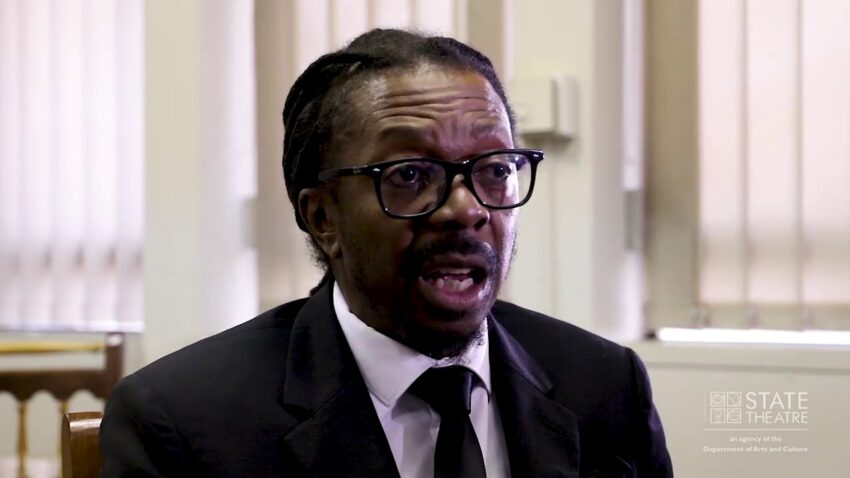
When a young boy in South Africa put pen to paper and wrote his very first play at the age of fifteen, few could have imagined that this act of youthful creativity would grow into one of the most decorated careers in African theatre history. Aubrey W.
Sekhabi is that boy, now a multiple award-winning playwright, director, arts administrator, and the longstanding Artistic Director of the South African State Theatre (SAST) in Pretoria. His productions have shaped conversations about history, justice, and identity across the country and beyond, making him one of the most consequential figures in South African performing arts.
Born in 1970, Sekhabi has spent over four decades building, nurturing, and transforming South African theatre from the inside. From his early days writing scripts as a teenager to leading one of the country’s most prestigious performing arts institutions, his journey is a testament to raw talent fortified by discipline, academic rigour, and an unwavering belief in the power of storytelling. His landmark productions, including Rivonia Trial, Marikana – The Musical, and Freedom – The Musical — have not only won major awards but have also forced audiences to confront defining chapters of South African history.
Beyond his artistic contributions, Sekhabi has been a critical architect of institutional development. Under his watch at the South African State Theatre, over 1,652 in-house productions have been staged, more than 13,000 jobs have been created for artists, and over three million audience members have experienced the theatre’s work. His influence extends into television, international arts diplomacy, and the mentorship of a new generation of South African directors and producers.
Profile
| Full Name | Aubrey W. Sekhabi |
| Born | 1970 |
| Age | 55 years old |
| Birthplace | South Africa |
| Nationality | South African |
| Occupation | Playwright, Theatre Director, Arts Administrator |
| Children | Shalate Sekhabi (daughter) |
| Net Worth | $100,000 – $300,000 |
Early Life
Aubrey W. Sekhabi was born in 1970 in South Africa. Growing up in a country defined by the tensions and injustices of the apartheid era, Sekhabi was exposed early on to a social landscape that would go on to deeply inform his storytelling.
Though detailed records of his specific hometown and family background remain largely private, what is well documented is that his passion for the arts ignited at a remarkably young age. By the time he was fifteen years old, he had already written his first play, a precocious achievement that signalled an extraordinary artistic destiny.
His childhood was spent developing a love for theatre, narrative, and the expressive power of the stage. The cultural and political climate of South Africa during his formative years, marked by resistance movements, township culture, and the struggle for liberation, gave him an intimate understanding of the stories that needed to be told. These early experiences would later manifest in his most celebrated works, many of which tackle the defining events and figures of South African history head-on.
Education
Aubrey Sekhabi received his formal early education in South Africa before going on to pursue higher learning at one of the country’s most prestigious universities. He enrolled at the University of the Witwatersrand (Wits) in 1988, where he studied at the School of Dramatic Art.
His academic journey at Wits culminated in a Master’s Degree in Dramatic Arts, which he completed with Cum Laude distinction, a remarkable achievement that underscored both his intellectual depth and creative brilliance.
He also holds an Honours Degree from the University of the Witwatersrand and later earned a Master of Business Administration (MBA) from the University of South Africa (UNISA), equipping him with the dual competencies of artistic vision and institutional leadership that have defined his administrative career.
Career
Aubrey Sekhabi’s professional career in the performing arts is one of the longest and most prolific in South African history, spanning more than four decades of continuous creative output. It all began in 1985 when, as a young man barely out of his teens, he wrote and produced his first play, Back to School. The following year, 1986, he followed it up with Save the People, establishing himself early as a voice with something urgent to say. These early works, written at a time when South Africa was still firmly under the grip of apartheid, demonstrated a boldness and social consciousness that would become his creative trademark.
In 1990, he produced Strong Hold, continuing to build his portfolio as he refined his craft. His early career was significantly shaped by his appointment in 1992, at just 24 years of age, as the Resident Director of the Bophuthatswana Arts Council. In the same year, he was elevated to the position of Artistic Director of the North-West Arts Drama Company, a role he would hold for eight years. This was a defining chapter in his development as an institutional leader, he was not only directing productions but shaping the artistic direction of an entire company during a pivotal moment in South African history, the country’s transition to democracy.
During his tenure at the North-West Arts Drama Company, Sekhabi continued to write and direct prolifically. In 1993 and 1994, he created Mika, one of his most talked-about early works. He also collaborated with other leading talents on productions such as Not With My Gun (1997) and The Stick (1999). At the same time, he served as Chief Executive for Arts and Culture in the North West Province, broadening his influence beyond the stage and into arts governance.
The year 2002 marked a watershed moment in Sekhabi’s career. He was appointed Artistic Director and Deputy CEO of the South African State Theatre in Pretoria, an institution that had long been regarded as the country’s premier performing arts venue. This appointment placed him at the helm of one of Africa’s largest theatre complexes, operating five performance venues. Under his leadership, he immediately set about transforming the theatre from a venue associated primarily with the apartheid cultural establishment into an inclusive, nationally representative institution. He established a development department that would go on to become a critical pipeline for emerging South African artists, directors, and producers.
Some of his most critically acclaimed directing work came through the mid-2000s. In 2006, he directed a landmark production of Sizwe Bansi is Dead — the iconic play by Athol Fugard, John Kani, and Winston Ntshona, featuring the original cast members John Kani and Winston Ntshona at the Baxter Theatre. The production was received as a historic cultural event. That same year, he created and executive-produced the medical drama series Hillside for SABC 2, demonstrating his versatility across theatre and television. He had earlier co-written the detective series Orlando for SABC 2 in 2000, and had also adapted the British comedy Keeping Up Appearances into the local South African series Mponeng.
The year 2010 brought Sekhabi to the global stage. He served as an advisor in the opening and closing ceremonies of the 2010 FIFA World Cup in South Africa, a project of immense national and international significance. He also directed the finale of the FIFA World Cup Final Draw and helmed the Thank You Africa Concert held in Dakar, Senegal. In the same year, he wrote and directed Kalushi – The Story of Solomon Mahlangu, a powerful tribute to the anti-apartheid activist and ANC member Solomon Mahlangu. He was also appointed to the Ministerial Task Team for Arts and Culture in 2009, and served on the council of the National English and Literary Museum.
In 2011, his production of Rivonia Trial won him a Naledi Theatre Award for Best Director, a recognition that cemented his position at the pinnacle of South African theatre. His 2014 production of Marikana – The Musical, which dramatised the 2012 Marikana massacre of striking mineworkers by South African security forces, became one of the most important theatrical works in post-apartheid South Africa. The production was nominated thirteen times at the 2015 Naledi Theatre Awards and won six, including Best Director, Best Production, and Best Score/Arrangement/Adaptation. The following year, he was nominated again for the Naledi Award for Best Director for Silent Voices (2013) and continued to rack up accolades with each new production.
In 2015 and 2016, in partnership with Theatre Royal Stratford East in London and Marcus Faustini Agencia of Brazil, Sekhabi introduced the concept of Home Theatre to Tshwane, staging thirty shows in thirty homes across the city, featuring thirty actors and collaborating with thirty student filmmakers. This groundbreaking initiative brought theatre directly into communities that had never experienced it in a formal venue setting. In 2017, he led a South African performing arts delegation to China as part of a BRICS mission under the Department of Arts and Culture, representing the People-to-People Mechanism (PPEM) Cultural Performance.
In 2018, he co-created Freedom – The Musical with Kabelo “BonafideBillie” Togoe, a production that earned him yet another Naledi Theatre Award for Best Score/Arrangement/Adaptation in 2019. During the COVID-19 pandemic in 2020, Sekhabi demonstrated remarkable foresight, the State Theatre had been filming and archiving productions for years prior to the pandemic, and this meant that when theatres were forced to close their doors, the SAST was able to stream a rich catalogue of previously recorded productions for audiences across South Africa. He also developed a suite of online programming under his leadership, including Onstage, Onset, Conversation with the Author, and SAST Fringe, which were eventually screened in Ster Kinekor cinemas nationwide and featured at the São Paulo 2nd Virtual International Movie Festival in 2021.
His 2024 Naledi Award win for Best Director of a Musical Theatre Production for Sophiatown demonstrated that, decades into his career, Sekhabi remains at the very top of his craft. He is also the co-founder and president of GBR Productions (Pty) Ltd, his own production company, and has previously served as Chief Executive Officer of Joburg Theatre, further extending his footprint in South African arts administration. Throughout his career, the State Theatre under his watch has staged over 1,652 in-house productions, creating over 13,169 jobs, supporting 333 artists with dramaturgical development, developing 153 community groups, and drawing over 3 million audience members to its stages.
Awards & Nominations
- Naledi Theatre Award – Best Director of a Play/Musical: Rivonia Trial (2011)
- Naledi Theatre Award – Nominated Best Director of a Play/Musical: Silent Voices (2013)
- Naledi Theatre Award – Best Director of a Play/Musical: Marikana – The Musical (2014)
- Naledi Theatre Award – Best Production: Marikana – The Musical (2015)
- Naledi Theatre Award – Best Score/Arrangement/Adaptation: Marikana – The Musical (2015)
- Naledi Theatre Award – Best Score/Arrangement/Adaptation: Freedom – The Musical (2019)
- Naledi Theatre Award – Best Director of a Musical Theatre Production: Sophiatown (2024)
Social Media
Aubrey Sekhabi maintains an active presence on social media, where he shares updates on his productions, the South African State Theatre, and the broader performing arts landscape. His platforms include:
- Twitter/X: @AubreySekhabi
- Facebook: Aubrey Sekhabi
Personal Life
Aubrey Sekhabi is an intensely private individual when it comes to his personal life, and details about his romantic relationships and marital status have not been made public. What is publicly known and a source of great pride for Sekhabi is his daughter, Shalate Sekhabi, who has followed in her father’s creative footsteps and carved out her own distinguished acting career.
Shalate is best known for her role as Shoki in the popular South African television drama House of Zwide, and is widely regarded as one of the country’s most exciting young acting talents. Father and daughter share an evident dedication to the performing arts that speaks to a deep familial creative legacy.
Sekhabi’s career has not been without controversy. At certain points during his tenure at the South African State Theatre, employees raised allegations of corruption, verbal harassment, sexual harassment, and unjust dismissals against him. An anonymous letter was reportedly sent to the Department of Arts and Culture seeking intervention into his conduct.
Sekhabi dismissed the allegations as a smear campaign, and he has continued in his role as Artistic Director. The allegations, while serious in nature, did not result in his removal from office, and he has since continued to deliver award-winning programming and institutional growth at the SAST.
Net Worth
Aubrey Sekhabi’s estimated net worth is reported to fall between $100,000 and $300,000 (approximately R1.8 million to R5.5 million at current rates).
This estimate reflects the financial realities of the South African arts sector, where even those at the highest levels of institutional leadership do not necessarily accumulate vast personal wealth.
His income is derived from a combination of sources: his salary as Artistic Director of the South African State Theatre, royalties and licensing fees from his extensive catalogue of plays and productions, revenue from his production company GBR Productions (Pty) Ltd, any consulting fees arising from his advisory and committee roles, and income generated from television projects including his SABC productions.
While Sekhabi’s financial net worth may be modest by global entertainment industry standards, his cultural net worth, the body of work, the institutions he has built, the careers he has launched, is incalculable.
Filmography & Theatre Productions
- Back to School (1985) – Playwright
- Save the People (1986) – Playwright/Director
- Strong Hold (1990) – Playwright/Director
- Mika (1993–1994) – Playwright/Director
- Not With My Gun (1997) – Director
- The Stick (1999) – Director
- Orlando (2000) – Co-writer, SABC 2 TV detective series
- Mponeng – Adaptor (based on the British series Keeping Up Appearances)
- Hillside (2006) – Creator, Writer, Executive Producer (SABC 2 medical drama)
- Sizwe Bansi is Dead (2006) – Director (featuring John Kani and Winston Ntshona)
- Interracial (2007) – Director
- Kalushi – The Story of Solomon Mahlangu (2010) – Writer/Director
- Rivonia Trial (2010) – Writer/Director
- Rhetorical (2012) – Director
- Silent Voices (2013) – Director
- Marikana – The Musical (2014) – Writer/Director
- Mother of Rain – Director
- Freedom – The Musical (2018) – Co-creator/Director
- Mother of Freedom (2021) – Director
- Sophiatown (2023/2024) – Director
- The Ladysmith Black Mambazo (Live) at the State Theatre (2018/2019) – Producer/Director
Conclusion
Aubrey W. Sekhabi is, by any measure, one of the most significant figures in the history of South African performing arts.
His career stretches across five decades, encompassing the apartheid era, the transition to democracy, and the complex cultural landscape of contemporary South Africa.
He has written stories that the country needed to tell, directed performances that challenged and moved millions, and built institutional structures that continue to sustain and develop South African artistic talent long after each show’s curtain falls.
From his debut play at age fifteen to his Naledi Award-winning production of Sophiatown in 2024, Sekhabi has never stopped growing, never stopped taking risks, and never stopped believing that the stage is one of the most powerful tools for social transformation available to any society.
As the South African State Theatre continues to evolve, with initiatives like SAST TV on the horizon and ongoing investment in young directors, producers, and community arts programmes, Sekhabi’s legacy is still very much being written.
For anyone who cares about African theatre, South African history, or the transformative power of the arts, the story of Aubrey Sekhabi is essential reading. His life’s work stands as proof that a single person, driven by passion and purpose, can reshape the cultural identity of an entire nation.